

Using the HTM database#
FESTIM can be coupled to the hydrogen transport properties database HTM.
H-transport-materials (HTM) is a python library for accessing hydrogen transport properties such as diffusivities, solubilities, recombination coefficients, etc. HTM is open-source and contributions to the database are more than welcome! See the online dashboard here!
Objectives:
Learn how to install and use the HTM library
Learn how to use and integrate HTM in FESTIM
Using the HTM Property Database#
First, install HTM by running:
pip install h-transport-materials
Now that HTM is installed, let’s look at at the HTM API.
The diffusivities in the HTM database are stored in htm.diffusivities. They can be filtered by material, isotope, author, year with the .filter() method.
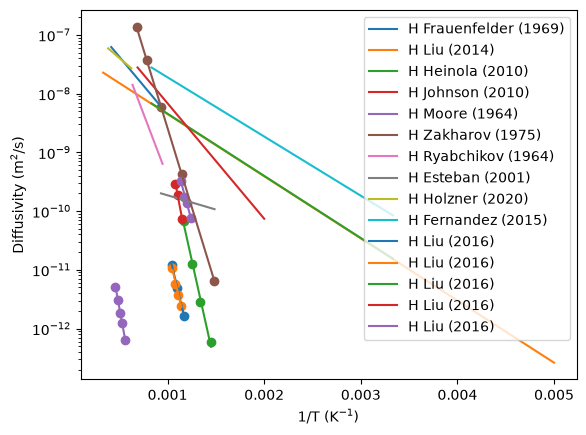
Let’s plot the different diffusivities for tungsten:
import h_transport_materials as htm

# filter only tungsten and H
diffusivities = htm.diffusivities.filter(material="tungsten").filter(isotope="h")

# plot the properties
htm.plotting.plot(diffusivities)

import matplotlib.pyplot as plt

plt.yscale("log")
plt.ylabel("Diffusivity (m$^2$/s)")
plt.legend()
plt.show()
/home/docs/checkouts/readthedocs.org/user_builds/festim-workshop/conda/latest/lib/python3.12/site-packages/pybtex/plugin/__init__.py:26: UserWarning: pkg_resources is deprecated as an API. See https://setuptools.pypa.io/en/latest/pkg_resources.html. The pkg_resources package is slated for removal as early as 2025-11-30. Refrain from using this package or pin to Setuptools<81.
  import pkg_resources
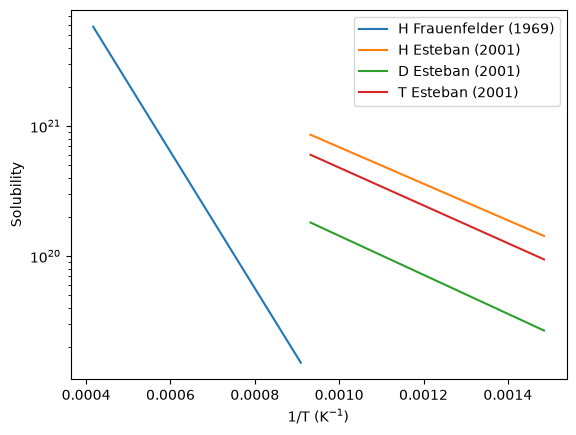
Now let’s take a look at the different solubilities for tungsten:
plt.figure()
# filter only tungsten and H
solubilities = htm.solubilities.filter(material="tungsten")

htm.plotting.plot(solubilities)


plt.yscale("log")
plt.ylabel("Solubility")
plt.legend()
plt.show()
Integrating with FESTIM#
To use HTM in FESTIM, we should first specify an author to get specific material properties. For example, let’s look at tungsten properties from Frauenfelder. We can filter the properties with .filter(author="frauenfelder"), obtaining a single htm.ArrheniusProperty object:
diffusivities = htm.diffusivities.filter(material="tungsten").filter(isotope="h").filter(author="frauenfelder")
D = diffusivities[0]

print(type(diffusivities))
print(type(D))
<class 'h_transport_materials.properties_group.PropertiesGroup'>
<class 'h_transport_materials.property.Diffusivity'>
A htm.ArrheniusProperty object has several useful attributes like .pre_exp which holds the pre-exponential factor, .act_energy for the activation energy but also .author and .year:
print(D)
        Author: Frauenfelder
        Material: tungsten
        Year: 1969
        Isotope: H
        Pre-exponential factor: 4.10×10⁻⁷ m²/s
        Activation energy: 3.90×10⁻¹ eV/particle
We can also look at the solubility:
S = htm.solubilities.filter(material="tungsten").filter(author="frauenfelder")[0]
print(S)
        Author: Frauenfelder
        Material: tungsten
        Year: 1969
        Isotope: H
        Pre-exponential factor: 8.88×10²³ particle/m³/Pa⁰⋅⁵
        Activation energy: 1.04×10⁰ eV/particle
These properties can then be used inside a FESTIM.Material object. This is extremely useful to avoid silly copy-pasting mistakes and typos in simulations.
import festim as F

tungsten = F.Material(
    D_0=D.pre_exp.magnitude, E_D=D.act_energy.magnitude,
    K_S_0=S.pre_exp.magnitude, E_K_S=S.act_energy.magnitude
    )

print(tungsten.D_0, tungsten.E_D)
4.1000000000000004e-07 0.3902769381762084