Reactions#
In FESTIM, chemical reactions between species are defined (in the bulk) with Reaction objects.
We will learn in this tutorial how these can be used a building blocks for many different problems.
Objectives
Define simple chemical reactions
Understand how trapping can be defined as a reaction
Define more complex reaction scheme (multi-occupancy trapping, decay, etc.)
Simple reaction#
We’ll start with a simple reaction between species A and B forming species C at a rate \(k\) and assume there is no backward reaction.
The governing equations for this problem are:
import festim as F
import numpy as np

my_model = F.HydrogenTransportProblem()


my_model.mesh = F.Mesh1D(np.linspace(0, 1, 100))

left_surf = F.SurfaceSubdomain1D(id=1, x=0)
right_surf = F.SurfaceSubdomain1D(id=2, x=1)

# assumes the same diffusivity for all species
material = F.Material(D_0=1, E_D=0)

vol = F.VolumeSubdomain1D(id=1, borders=[0, 1], material=material)

my_model.subdomains = [vol, left_surf, right_surf]
Reaction object need a list of reactants, a list of product (we’ll see later that it can be an empty list), as well as forward and backward reaction rates expressed as Arrhenius laws.
Let’s define three Species object, noting that Species C is immobile.
Tip
If your reaction rate isn’t an Arrhenius law but say a constant value, simply set the activation energy (E_k or E_p) to 0.
We can then define boundary conditions for all the species, temperature, settings, and run the model:
my_model.boundary_conditions = [
    # A BCs
    F.FixedConcentrationBC(left_surf, value=10, species=A),
    F.FixedConcentrationBC(right_surf, value=0, species=A),
    # B BCs
    F.FixedConcentrationBC(left_surf, value=0, species=B),
    F.FixedConcentrationBC(right_surf, value=5, species=B),
]

my_model.temperature = 300

my_model.settings = F.Settings(atol=1e-10, rtol=1e-10, final_time=50)

my_model.settings.stepsize = F.Stepsize(1)

my_model.initialise()
my_model.run()
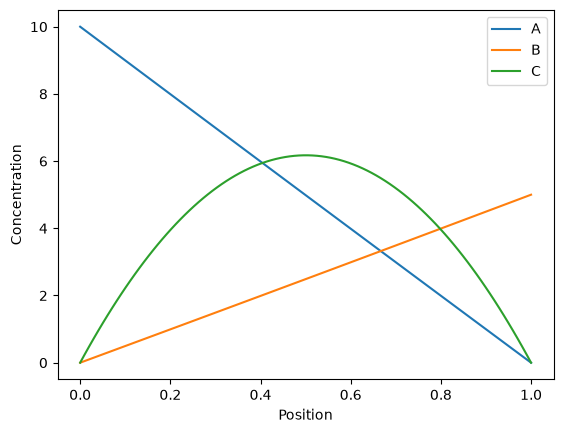
As expected, the concentration of Species C is highest where the product \(c_A c_B\) is highest.
Two-way reaction#
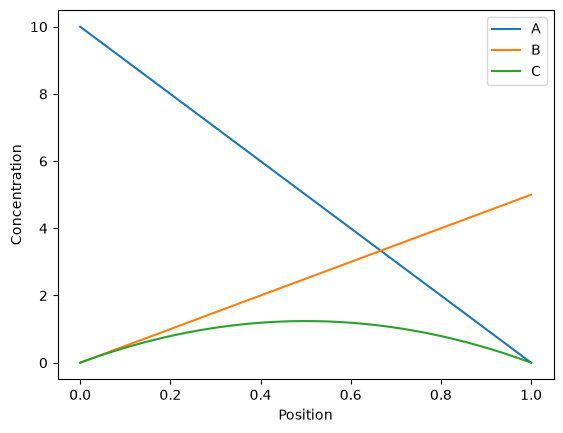
The previous example can be very easily extended to a two-way reaction:
The governing equations for this problem are:
my_model = F.HydrogenTransportProblem()

A = F.Species("A")
B = F.Species("B")
C = F.Species("C", mobile=False)
my_model.species = [A, B, C]

my_model.mesh = F.Mesh1D(np.linspace(0, 1, 100))

left_surf = F.SurfaceSubdomain1D(id=1, x=0)
right_surf = F.SurfaceSubdomain1D(id=2, x=1)

# assumes the same diffusivity for all species
material = F.Material(D_0=1, E_D=0)

vol = F.VolumeSubdomain1D(id=1, borders=[0, 1], material=material)

my_model.subdomains = [vol, left_surf, right_surf]

my_model.reactions = [
    F.Reaction(
        reactant=[A, B],
        product=[C],
        k_0=0.01,
        E_k=0,
        p_0=0.1,
        E_p=0,
        volume=vol,
    )
]

my_model.boundary_conditions = [
    # A BCs
    F.FixedConcentrationBC(left_surf, value=10, species=A),
    F.FixedConcentrationBC(right_surf, value=0, species=A),
    # B BCs
    F.FixedConcentrationBC(left_surf, value=0, species=B),
    F.FixedConcentrationBC(right_surf, value=5, species=B),
]

my_model.temperature = 300

my_model.settings = F.Settings(atol=1e-10, rtol=1e-10, final_time=50)

my_model.settings.stepsize = F.Stepsize(1)

my_model.initialise()
my_model.run()
Chain reaction#
Here we consider a reaction scheme where mobile species A and B react to form species C (immobile). Species C then reacts on its own to form species D.
The governing equations of this system are:
To implement this in a FESTIM model, one simply has to add both reactions with two Reaction objects.
my_model = F.HydrogenTransportProblem()

A = F.Species("A")
B = F.Species("B")
C = F.Species("C", mobile=False)
D = F.Species("D")
my_model.species = [A, B, C, D]

my_model.mesh = F.Mesh1D(np.linspace(0, 1, 100))

left_surf = F.SurfaceSubdomain1D(id=1, x=0)
right_surf = F.SurfaceSubdomain1D(id=2, x=1)

# assumes the same diffusivity for all species
material = F.Material(D_0=1, E_D=0)

vol = F.VolumeSubdomain1D(id=1, borders=[0, 1], material=material)

my_model.subdomains = [vol, left_surf, right_surf]

my_model.reactions = [
    F.Reaction(
        reactant=[A, B],
        product=[C],
        k_0=0.01,
        E_k=0,
        p_0=0.1,
        E_p=0,
        volume=vol,
    ),
    F.Reaction(
        reactant=[C],
        product=[D],
        k_0=0.2,
        E_k=0,
        p_0=0,
        E_p=0,
        volume=vol,
    ),
]

my_model.boundary_conditions = [
    # A BCs
    F.FixedConcentrationBC(left_surf, value=10, species=A),
    F.FixedConcentrationBC(right_surf, value=0, species=A),
    # B BCs
    F.FixedConcentrationBC(left_surf, value=0, species=B),
    F.FixedConcentrationBC(right_surf, value=5, species=B),
]

my_model.temperature = 300

my_model.settings = F.Settings(atol=1e-10, rtol=1e-10, final_time=50)

my_model.settings.stepsize = F.Stepsize(1)

my_model.initialise()
my_model.run()
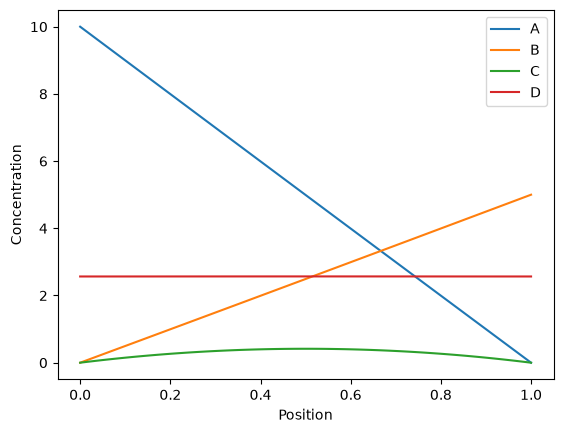
After 5 s, we can see that the concentration of D is fairly flat. This is because D is mobile, but the boundary conditions for this species are no-flux conditions. Species D will therefore diffuse but won’t “escape” the domain.
Trapping#
Hydrogen trapping can be represented as a reaction too. Here we consider mobile hydrogen (\(\mathrm{H}\)) reacting with an empty trap (\([\ ]\)) to form trapped hydrogen (\(\mathrm{[H]}\)):
The governing equations for this problem are:
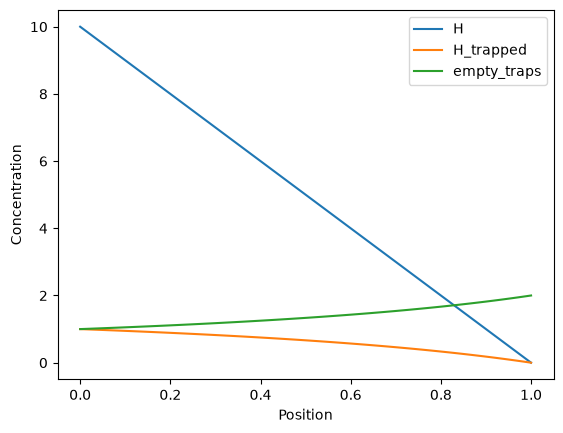
Following what was done in the Species tutorial, we will show that empty traps can be represented either as an explicit or implicit species.
Note
The TDS simulation tutorial provides a more complete and realistic example including temperature-dependent trapping/detrapping rates.
Explicit trapping sites#
Here, we treat the empty trapping sites as an explicit species with an initial concentration.
my_model = F.HydrogenTransportProblem()
my_model.mesh = F.Mesh1D(np.linspace(0, 1, 100))

material = F.Material(D_0=1, E_D=0)

vol = F.VolumeSubdomain1D(id=1, borders=[0, 1], material=material)

mobile_H = F.Species("H")
trapped_H = F.Species("H_trapped", mobile=False)
empty_traps = F.Species("empty_traps", mobile=False)

my_model.species = [mobile_H, trapped_H, empty_traps]

material = F.Material(D_0=1, E_D=0)

vol = F.VolumeSubdomain1D(id=1, borders=[0, 1], material=material)
my_model.initial_conditions = [F.InitialConcentration(value=2, species=empty_traps, volume=vol)]
Note
Here we set the empty traps as immobile, but they could diffuse in the material too by setting mobile=True.
left_surf = F.SurfaceSubdomain1D(id=1, x=0)
right_surf = F.SurfaceSubdomain1D(id=2, x=1)

my_model.subdomains = [vol, left_surf, right_surf]

my_model.reactions = [
    F.Reaction(
        reactant=[mobile_H, empty_traps],
        product=[trapped_H],
        k_0=0.01,
        E_k=0,
        p_0=0.1,
        E_p=0,
        volume=vol,
    ),
]

my_model.boundary_conditions = [
    F.FixedConcentrationBC(left_surf, value=10, species=mobile_H),
    F.FixedConcentrationBC(right_surf, value=0, species=mobile_H),
]

my_model.temperature = 300

my_model.settings = F.Settings(atol=1e-10, rtol=1e-10, final_time=50)

my_model.settings.stepsize = F.Stepsize(1)

my_model.initialise()
my_model.run()
Implicit trapping sites#
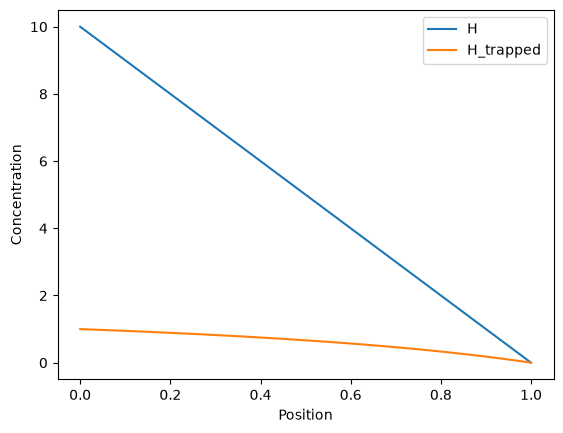
As showed in the Species tutorial, in this case, empty traps can be defined as an implicit species, and their concentration is defined as:
my_model = F.HydrogenTransportProblem()
my_model.mesh = F.Mesh1D(np.linspace(0, 1, 100))

mobile_H = F.Species("H")
trapped_H = F.Species("H_trapped", mobile=False)
empty_traps = F.ImplicitSpecies(n=2, others=[trapped_H])

my_model.species = [mobile_H, trapped_H]

left_surf = F.SurfaceSubdomain1D(id=1, x=0)
right_surf = F.SurfaceSubdomain1D(id=2, x=1)

material = F.Material(D_0=1, E_D=0)

vol = F.VolumeSubdomain1D(id=1, borders=[0, 1], material=material)

my_model.subdomains = [vol, left_surf, right_surf]

my_model.reactions = [
    F.Reaction(
        reactant=[mobile_H, empty_traps],
        product=[trapped_H],
        k_0=0.01,
        E_k=0,
        p_0=0.1,
        E_p=0,
        volume=vol,
    ),
]

my_model.boundary_conditions = [
    F.FixedConcentrationBC(left_surf, value=10, species=mobile_H),
    F.FixedConcentrationBC(right_surf, value=0, species=mobile_H),
]

my_model.temperature = 300

my_model.settings = F.Settings(atol=1e-10, rtol=1e-10, final_time=50)

my_model.settings.stepsize = F.Stepsize(1)

my_model.initialise()
my_model.run()
Convenience class for trapping#
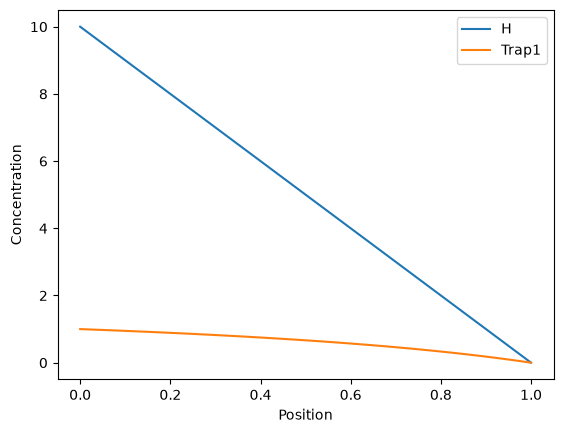
For simple cases (ie. one mobile species, one hydrogen per trap), FESTIM has a convenience class Trap to simplify the inputs.
With this class, all that is needed is defining the trapping rates, the mobile species, the total number of traps. It provides a slightly more compact way of defining traps, at the cost of flexibility.
my_model = F.HydrogenTransportProblem()
my_model.mesh = F.Mesh1D(np.linspace(0, 1, 100))

material = F.Material(D_0=1, E_D=0)
left_surf = F.SurfaceSubdomain1D(id=1, x=0)
right_surf = F.SurfaceSubdomain1D(id=2, x=1)
vol = F.VolumeSubdomain1D(id=1, borders=[0, 1], material=material)
my_model.subdomains = [vol, left_surf, right_surf]

mobile_H = F.Species("H")
my_model.species = [mobile_H]

my_model.traps = [
    F.Trap(
        mobile_species=mobile_H,
        k_0=0.01,
        E_k=0,
        p_0=0.1,
        E_p=0,
        volume=vol,
        n=2,  # number of traps
        name="Trap1",
    )
]

my_model.boundary_conditions = [
    F.FixedConcentrationBC(left_surf, value=10, species=mobile_H),
    F.FixedConcentrationBC(right_surf, value=0, species=mobile_H),
]

my_model.temperature = 300
my_model.settings = F.Settings(atol=1e-10, rtol=1e-10, final_time=50)
my_model.settings.stepsize = F.Stepsize(1)

my_model.initialise()
my_model.run()
Multi-occupancy trapping#
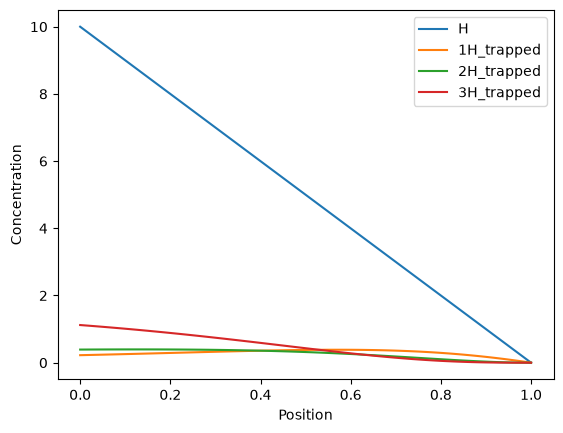
So far we’ve assumed that a trap could only accomodate one H atom. However, it is possible to simulate the fact that one trap can hold several atoms. This is called the multi-occupancy trap model.
Let’s consider a trap with 3 occupancy levels. We have the following reaction scheme:
The underlying governing equations are:
with:
my_model = F.HydrogenTransportProblem()
my_model.mesh = F.Mesh1D(np.linspace(0, 1, 100))


mobile_H = F.Species("H")
trapped_1H = F.Species("1H_trapped", mobile=False)
trapped_2H = F.Species("2H_trapped", mobile=False)
trapped_3H = F.Species("3H_trapped", mobile=False)
empty_traps = F.ImplicitSpecies(n=2, others=[trapped_1H, trapped_2H, trapped_3H])

my_model.species = [mobile_H, trapped_1H, trapped_2H, trapped_3H]

left_surf = F.SurfaceSubdomain1D(id=1, x=0)
right_surf = F.SurfaceSubdomain1D(id=2, x=1)

material = F.Material(D_0=1, E_D=0)

vol = F.VolumeSubdomain1D(id=1, borders=[0, 1], material=material)

my_model.subdomains = [vol, left_surf, right_surf]

my_model.reactions = [
    F.Reaction(
        reactant=[mobile_H, empty_traps],
        product=[trapped_1H],
        k_0=0.01,
        E_k=0,
        p_0=0.1,
        E_p=0,
        volume=vol,
    ),
    F.Reaction(
        reactant=[mobile_H, trapped_1H],
        product=[trapped_2H],
        k_0=0.02,
        E_k=0,
        p_0=0.1,
        E_p=0,
        volume=vol,
    ),
    F.Reaction(
        reactant=[mobile_H, trapped_2H],
        product=[trapped_3H],
        k_0=0.03,
        E_k=0,
        p_0=0.1,
        E_p=0,
        volume=vol,
    ),
]

my_model.boundary_conditions = [
    F.FixedConcentrationBC(left_surf, value=10, species=mobile_H),
    F.FixedConcentrationBC(right_surf, value=0, species=mobile_H),
]

my_model.temperature = 300

my_model.settings = F.Settings(atol=1e-10, rtol=1e-10, final_time=50)

my_model.settings.stepsize = F.Stepsize(1)

my_model.initialise()
my_model.run()
Two species, one trap#
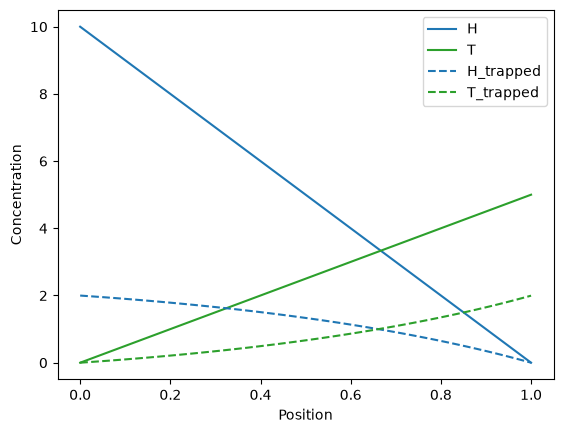
Now we consider a unique trapping site that can react with two different mobile species H and D:
The governing equations for this problem are:
with
\(c_\mathrm{m,i}\) is the concentration of species i and \(c_\mathrm{t,i}\) is the concentration of species [i].
my_model = F.HydrogenTransportProblem()
my_model.mesh = F.Mesh1D(np.linspace(0, 1, 100))


mobile_H = F.Species("H")
mobile_T = F.Species("T")
trapped_H = F.Species("H_trapped", mobile=False)
trapped_T = F.Species("T_trapped", mobile=False)
empty_traps = F.ImplicitSpecies(n=2, others=[trapped_H, trapped_T])

my_model.species = [mobile_H, mobile_T, trapped_H, trapped_T]


left_surf = F.SurfaceSubdomain1D(id=1, x=0)
right_surf = F.SurfaceSubdomain1D(id=2, x=1)

material = F.Material(D_0=1, E_D=0)

vol = F.VolumeSubdomain1D(id=1, borders=[0, 1], material=material)

my_model.subdomains = [vol, left_surf, right_surf]

my_model.reactions = [
    F.Reaction(
        reactant=[mobile_H, empty_traps],
        product=[trapped_H],
        k_0=0.1,
        E_k=0,
        p_0=0.001,
        E_p=0,
        volume=vol,
    ),
    F.Reaction(
        reactant=[mobile_T, empty_traps],
        product=[trapped_T],
        k_0=0.1,
        E_k=0,
        p_0=0.001,
        E_p=0,
        volume=vol,
    ),
]

my_model.boundary_conditions = [
    F.FixedConcentrationBC(left_surf, value=10, species=mobile_H),
    F.FixedConcentrationBC(right_surf, value=0, species=mobile_H),
    F.FixedConcentrationBC(left_surf, value=0, species=mobile_T),
    F.FixedConcentrationBC(right_surf, value=5, species=mobile_T),
]

my_model.temperature = 300

my_model.settings = F.Settings(atol=1e-10, rtol=1e-10, final_time=20)

my_model.settings.stepsize = F.Stepsize(1)

my_model.initialise()
my_model.run()
Isotope swapping#
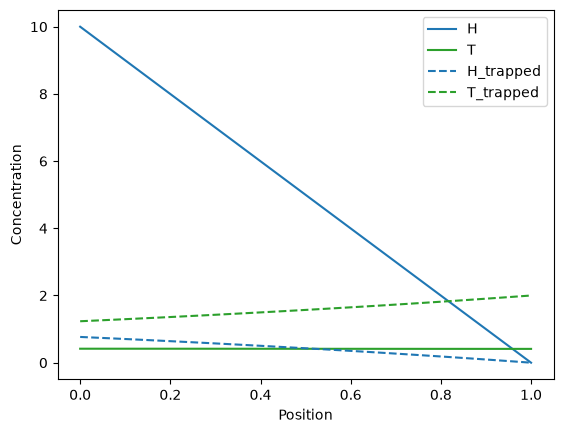
Reaction objects can have multiple products. This is useful to simulate things like isotope swapping where a mobile species reacts with a trapped species, and swap their positions:
In this example we consider the above reaction, with an initial condition for the trapped T concentration and mobile H diffusing in the domain, slowly swapping trapped T.
The governing equations for this problem are:
my_model = F.HydrogenTransportProblem()
my_model.mesh = F.Mesh1D(np.linspace(0, 1, 100))

material = F.Material(D_0=1, E_D=0)

vol = F.VolumeSubdomain1D(id=1, borders=[0, 1], material=material)

mobile_H = F.Species("H")
mobile_T = F.Species("T")
trapped_H = F.Species("H_trapped", mobile=False)
trapped_T = F.Species("T_trapped", mobile=False)

my_model.species = [mobile_H, mobile_T, trapped_H, trapped_T]

my_model.initial_conditions = [
    F.InitialConcentration(value=2, species=trapped_T, volume=vol),
]

left_surf = F.SurfaceSubdomain1D(id=1, x=0)
right_surf = F.SurfaceSubdomain1D(id=2, x=1)


my_model.subdomains = [vol, left_surf, right_surf]

my_model.initial_conditions = [
    F.InitialConcentration(value=2, species=trapped_T, volume=vol),
]

my_model.reactions = [
    F.Reaction(
        reactant=[mobile_H, trapped_T],
        product=[mobile_T, trapped_H],
        k_0=0.005,
        E_k=0,
        p_0=0.005,
        E_p=0,
        volume=vol,
    ),
]

my_model.boundary_conditions = [
    F.FixedConcentrationBC(left_surf, value=10, species=mobile_H),
    F.FixedConcentrationBC(right_surf, value=0, species=mobile_H),
]

my_model.temperature = 300

my_model.settings = F.Settings(atol=1e-10, rtol=1e-10, final_time=10)

my_model.settings.stepsize = F.Stepsize(1)

my_model.initialise()
my_model.run()
Annihilation#
Reaction objects can also have no products at all, simulating annihiliation reactions.
Radioactive decay#
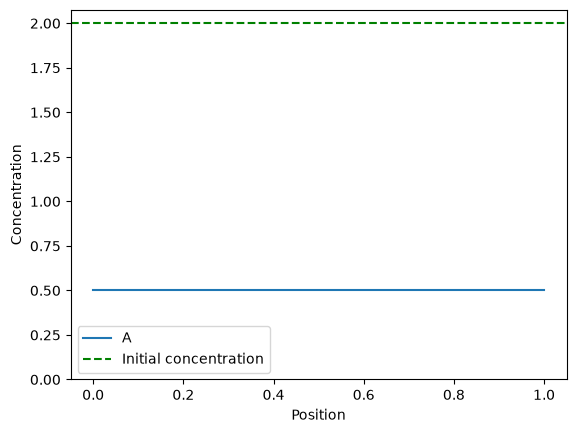
When dealing with radioactive species, this type of reaction can be used to simulate radioactive decay. The rate of the reaction being equal to the decay constant.
Here we consider a species A decaying with a decay constant \(\lambda\).
The governing equation is:
my_model = F.HydrogenTransportProblem()
my_model.mesh = F.Mesh1D(np.linspace(0, 1, 100))

material = F.Material(D_0=1, E_D=0)
vol = F.VolumeSubdomain1D(id=1, borders=[0, 1], material=material)
left_surf = F.SurfaceSubdomain1D(id=1, x=0)
right_surf = F.SurfaceSubdomain1D(id=2, x=1)

my_model.subdomains = [vol, left_surf, right_surf]

A = F.Species("A")

my_model.species = [A]
left_surf = F.SurfaceSubdomain1D(id=1, x=0)
right_surf = F.SurfaceSubdomain1D(id=2, x=1)

material = F.Material(D_0=1, E_D=0)

vol = F.VolumeSubdomain1D(id=1, borders=[0, 1], material=material)

my_model.subdomains = [vol, left_surf, right_surf]

my_model.initial_conditions = [F.InitialConcentration(value=1, species=A, volume=vol)]

my_model.reactions = [
    F.Reaction(reactant=[A], k_0=1, E_k=0, volume=vol),
]

my_model.temperature = 300

my_model.settings = F.Settings(atol=1e-10, rtol=1e-10, final_time=1)

my_model.settings.stepsize = F.Stepsize(1)

my_model.initialise()
my_model.run()
Vacancy-interstitial annihilation#
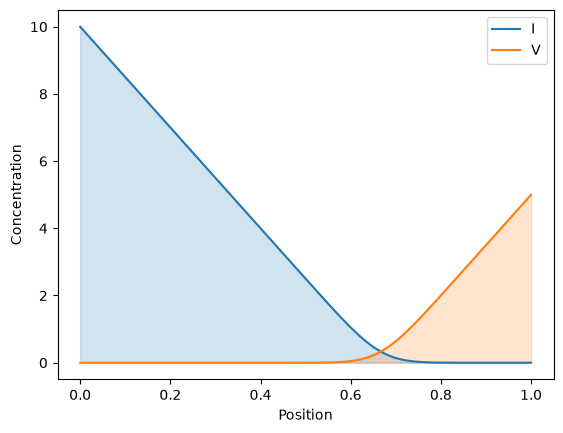
Another use case of this type of reaction is metal interstitial atoms recombining with vacancies (both forming a Frenkel pair) and annihilate.
In this example, we define two mobile species I and V, both diffusing from one side of the 1D domain and annihilating.
The governing equations are:
my_model = F.HydrogenTransportProblem()
my_model.mesh = F.Mesh1D(np.linspace(0, 1, 100))

I = F.Species("I")
V = F.Species("V")

my_model.species = [I, V]

left_surf = F.SurfaceSubdomain1D(id=1, x=0)
right_surf = F.SurfaceSubdomain1D(id=2, x=1)

material = F.Material(D_0=1, E_D=0)

vol = F.VolumeSubdomain1D(id=1, borders=[0, 1], material=material)

my_model.subdomains = [vol, left_surf, right_surf]

my_model.reactions = [
    F.Reaction(reactant=[I, V], k_0=1000, E_k=0, volume=vol),
]
my_model.boundary_conditions = [
    F.FixedConcentrationBC(left_surf, value=10, species=I),
    F.FixedConcentrationBC(right_surf, value=0, species=I),
    F.FixedConcentrationBC(left_surf, value=0, species=V),
    F.FixedConcentrationBC(right_surf, value=5, species=V),
]
my_model.temperature = 300

my_model.settings = F.Settings(atol=1e-10, rtol=1e-10, transient=False)

my_model.initialise()
my_model.run()